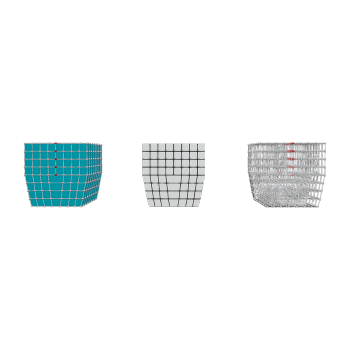
Crystal structure defects (3D schematic diagram of microscopic particles)

In nature, crystals are never perfect and contain various types of defects (defects). In this 3D model, a screw dislocation defect is shown. Edge dislocations occur due to the introduction or elimination of additional atomic rows/planes in the crystal.
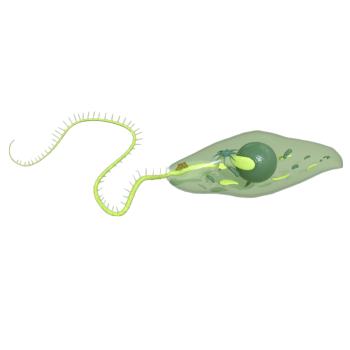
Amoeba (microscopic 3D schematic)
Amoeba is a unicellular animal belonging to the genus Amoeba in the family Proteaceae of the order Proteobacteria. There is only a thin plasma membrane on the surface of the body, and the cytoplasm inside the membrane is relatively transparent, which can be clearly distinguished into two parts: endoplasmic and extracellular; Pseudo feet are shaped like fingers, leaves, or needles; Insects can undergo special deformation movements through pseudopodia, which change with the expansion and contraction of pseudopodia; Pseudo foot not only has the function of movement, but also has the function of feeding. After wrapping food, it undergoes intracellular digestion. Named after the constant changes in body shape caused by the movement of the parasite's cytoplasm.
Blue algae (microscopic 3D schematic diagram)
Cyanobacteria, also known as blue-green algae, are a type of large single-cell prokaryotic organism with a long evolutionary history, Gram negative staining, no flagella, containing chlorophyll-a but not chloroplasts (different from eukaryotic algae), and capable of oxygen producing photosynthesis. The difference from photosynthetic bacteria is that photosynthetic bacteria (red snails) undergo more primitive photosynthetic phosphorylation and do not release oxygen during the reaction process, making them anaerobic organisms, while cyanobacteria can carry out photosynthesis and release oxygen.
Spiral arranged nanowires (microscopic 3D schematic diagram)
Spiral arranged nanowires are a type of nanomaterial with a helical structure, typically formed by self-assembly or guided growth of one-dimensional nanowires. This structure has important applications in materials science and nanotechnology.
Phospholipid bilayers (microscopic 3D schematic)
Phospholipid bilayer is a structure composed of two layers of phospholipid molecules and is a fundamental component of the cell membrane. A hydrophilic "head" and a hydrophobic "tail". The hydrophilic head faces the aqueous phase, while the hydrophobic tails approach each other, forming a bilayer structure. Having fluidity, allowing embedded proteins to move within the membrane. Being able to selectively allow certain substances to pass through while blocking others. The phospholipid bilayer isolates the interior of cells from the external environment. Through embedded proteins, phospholipid bilayers can regulate the entry and exit of ions, nutrients, and waste.
Multilayer phosphorene structure (microscopic 3D schematic diagram)
Phosphorene is a two-dimensional material composed of a single layer of black phosphorus atoms, possessing unique physical and chemical properties. Phosphocene is a single-layer phosphorus atom detached from black phosphorus, exhibiting a honeycomb like lattice arrangement but with a wavy bent structure.
Molecular structure of cyclodextrin
Cyclodextrin (CD) is a class of cyclic oligosaccharides formed by glucose units connected by α -1,4-glycosidic bonds. According to the number of glucose units contained, cyclodextrins are mainly divided into three types: alpha cyclodextrin (6 glucose units), beta cyclodextrin (7 glucose units), and gamma cyclodextrin (8 glucose units).
Popular Models
Shrine
115 View
King Kong Hercules Wood Carving
166 View
The bell tower of a Japanese temple
189 View
Random Model
Big grouse specimen
152 View
stylized camper
166 View
Sagittal view of skull and mandible
126 View
French screw shell
191 View
Leather armchair
136 View
Black Vintage Wooden Table Lamp
137 View